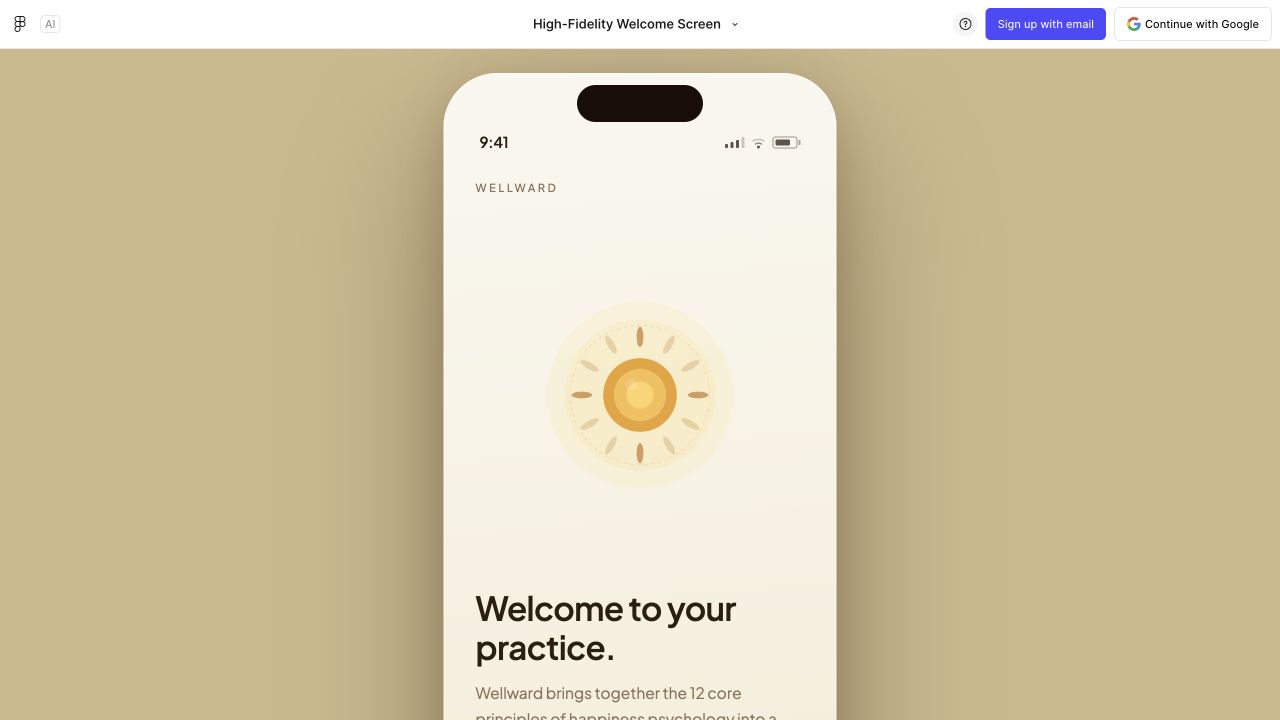
Wellward began while I was reading The How of Happiness by Sonja Lyubomirsky, a psychology researcher and professor at my university. The book describes 12 practices associated with well-being, including random acts of kindness.
I tried the practice myself. The book also emphasizes variation because of hedonic adaptation: repeating the same behavior can make it feel normal over time and reduce its emotional impact. I wondered whether a companion product could help people practice these ideas in a more varied, sustainable way.
Hedonic adaptation
Variation matters
Product hypothesis
Initial product hypothesis
I imagined a wheel of kindness activities: spin to receive a different action to try. The idea was to preserve novelty while translating a psychological concept into a concrete interaction.
Spin
Receive an act
Do it
Reflect
An initial interaction hypothesis, not the final product architecture.
02 / WELLWARD
I researched the behavior before choosing the product.
I used Perplexity to synthesize broad patterns in how people described sustaining gratitude, savoring, and acts of kindness, then crafted questions for Reddit communities to explore those behaviors more directly.
Rather than assuming the interventions themselves were the problem, I looked at a more product-relevant question:
What makes a psychologically useful practice difficult to sustain once it leaves the research study and enters someone's actual life?
Exploratory community research
Not formal academic validation.
COMMUNITY + BEHAVIORAL RESEARCH
Where well-being practices break down in real life
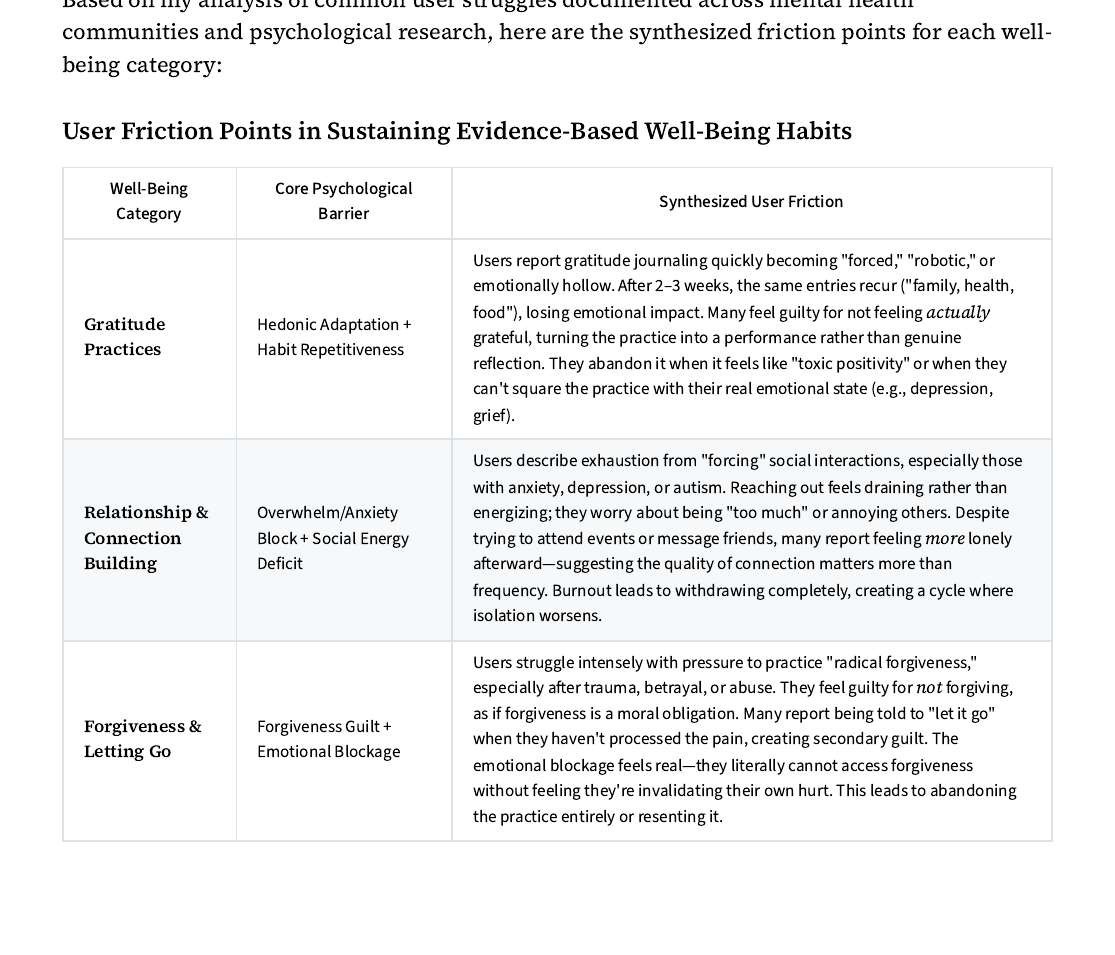
I explored friction across gratitude, relationships, forgiveness, savoring, and exercise to understand why psychologically useful practices can become difficult to sustain outside controlled settings.
The synthesis surfaced recurring barriers including repetition, emotional mismatch, anxiety, guilt, and low mental energy—shifting the product question from 'How do I make people more disciplined?' to 'How might the product reduce the friction surrounding the practice?'
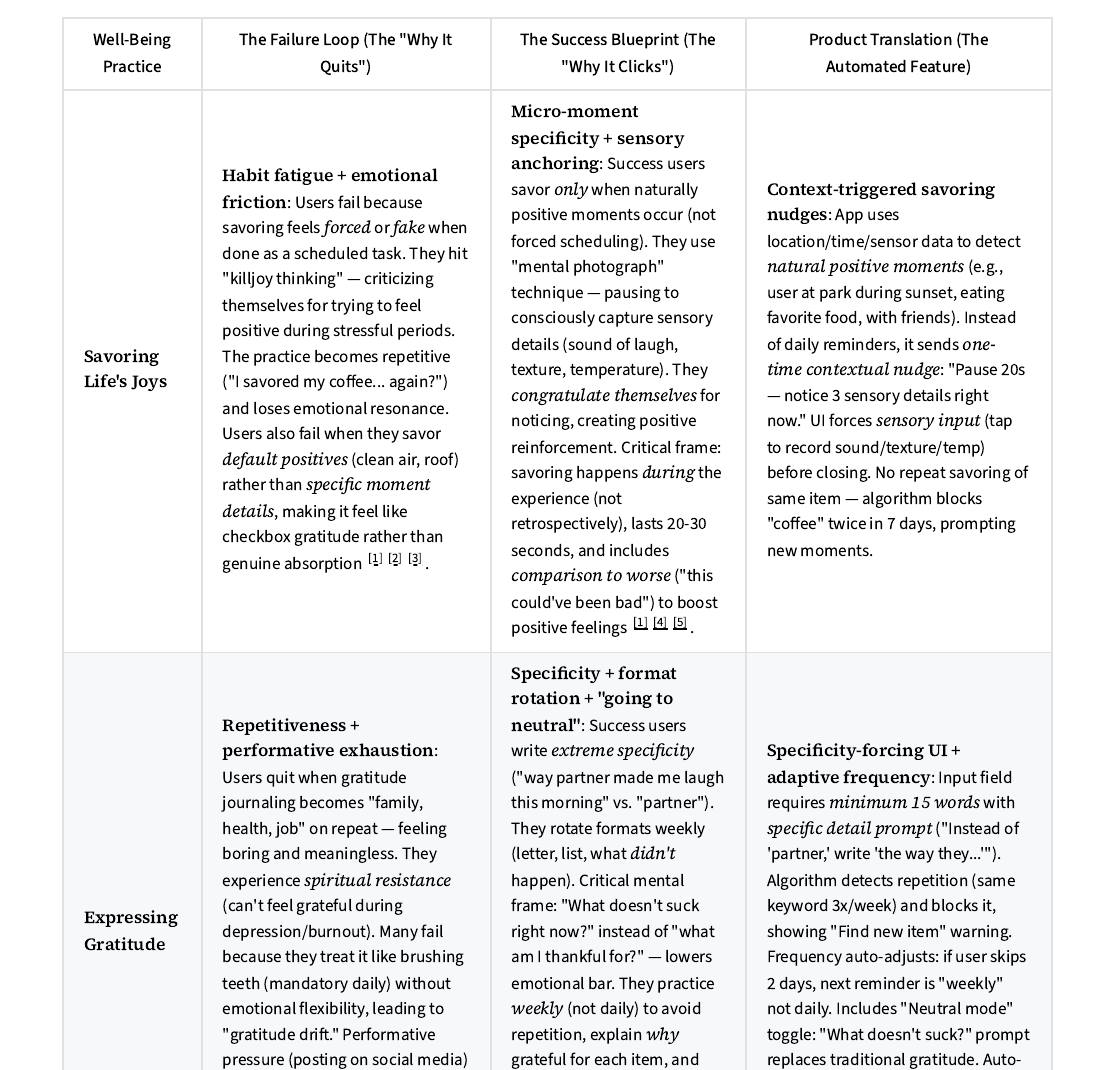
I then narrowed the research to savoring, gratitude, and kindness, comparing recurring failure loops with the conditions that appeared to make each practice easier to sustain.
I organized those patterns into a failure → success → product matrix, using the synthesis to generate hypotheses around specificity, flexible cadence, lower-pressure prompts, boundaries, and less performative engagement.
Perplexity-assisted exploratory product research using psychology literature and community discussions. Used for product discovery, not formal behavioral validation.
03 / WELLWARD
I decomposed the market before comparing products.
Finding direct competitors was difficult because Wellward addressed a broad well-being problem made up of smaller practices. I broke the problem down by practice, studying each behavior's user journey before comparing products at the broader system level.
Well-being↓
GratitudeKindnessSavoring…
↓Gratitude Plus deep dive
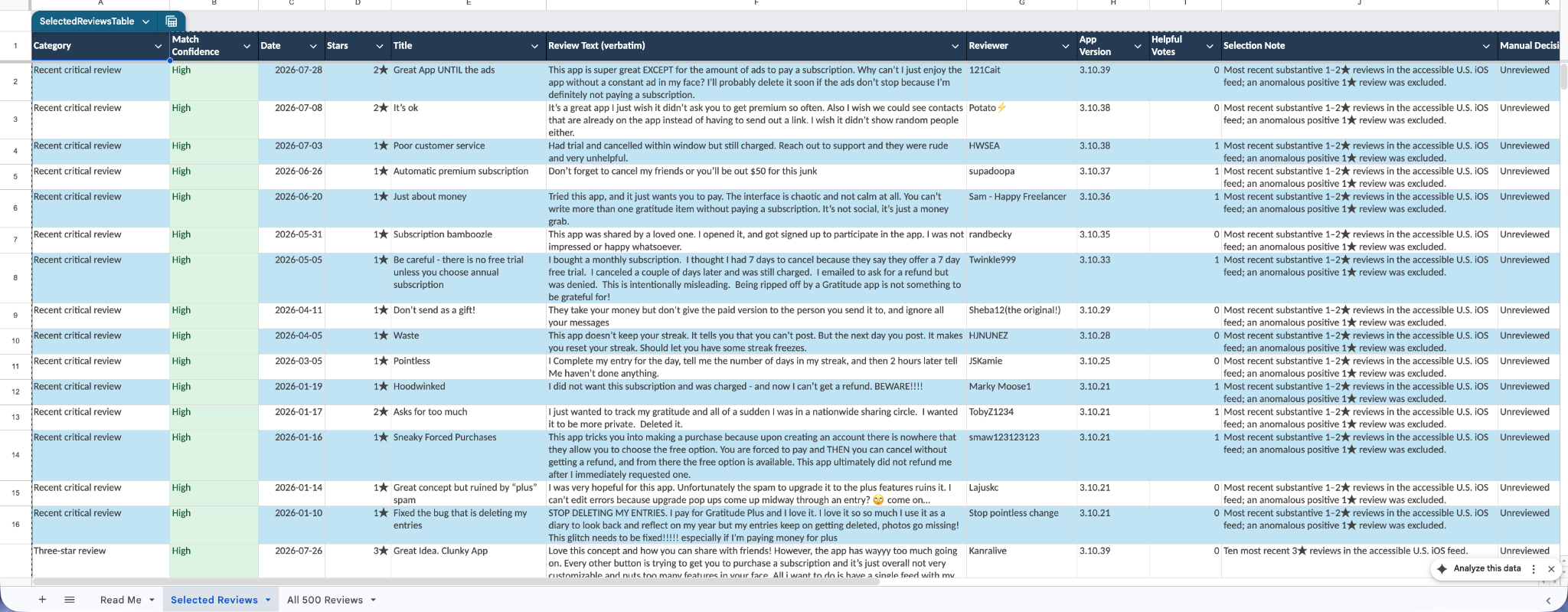
I started with gratitude. I found Gratitude Plus, used the app for a week, and used AI to help analyze 500 competitor user reviews. I looked for recurring patterns, including social rituals and subscription friction, then translated those observations into product requirements and roadmap considerations.
Research artifact 01
Building a review sample I could actually inspect
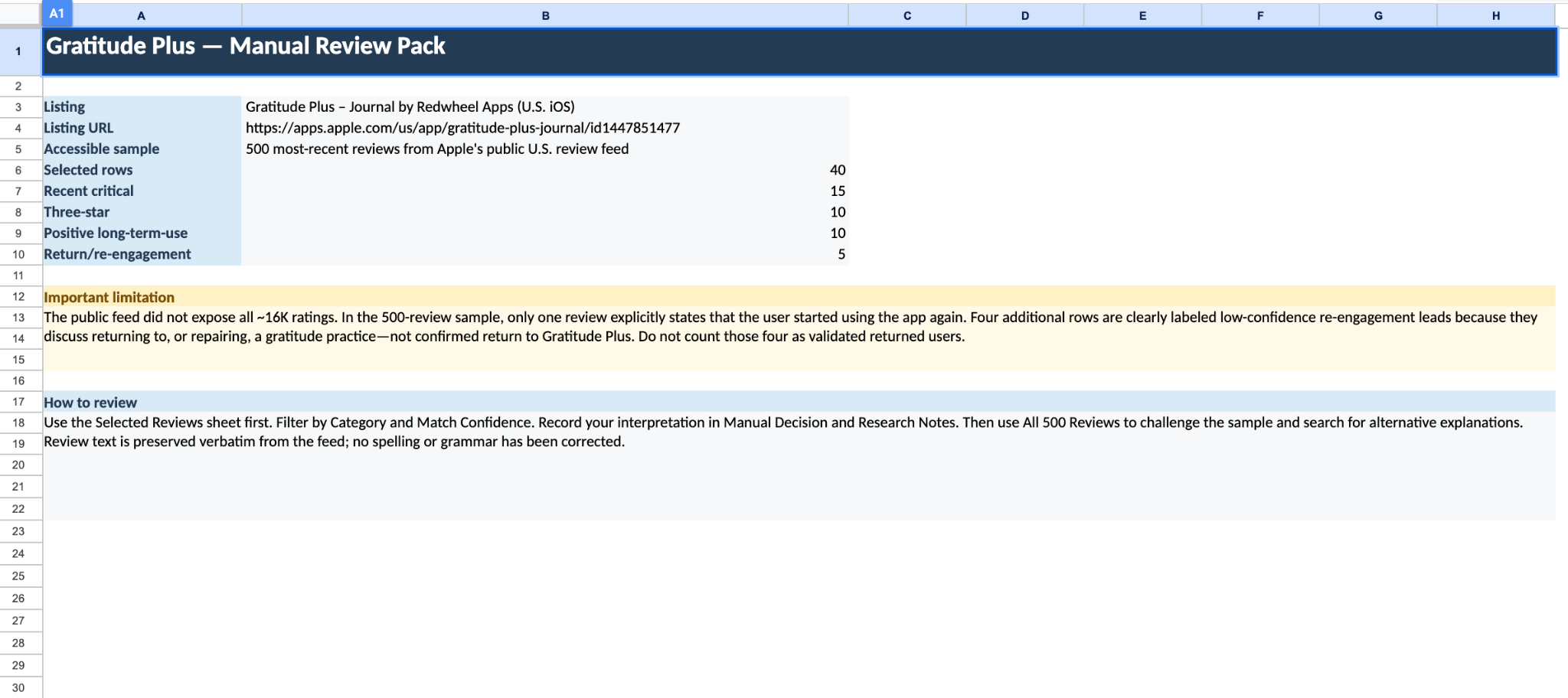
I worked from the 500 most-recent U.S. iOS reviews available through Apple’s public review feed, then created a 40-review inspection set across recent critical, three-star, positive long-term-use, and re-engagement signals. The public feed did not expose all ~16K ratings, so I treated the dataset as a sample rather than the full customer population.
The workflow also required me to use the full 500-review dataset to challenge patterns found in the selected sample and look for alternative explanations.
500
Public reviews analyzed
40
Reviews in inspection set
4
Research signal categories
Source: Apple U.S. public review feed. Exploratory competitor-review research.
The original product thesis before Wellward expanded.
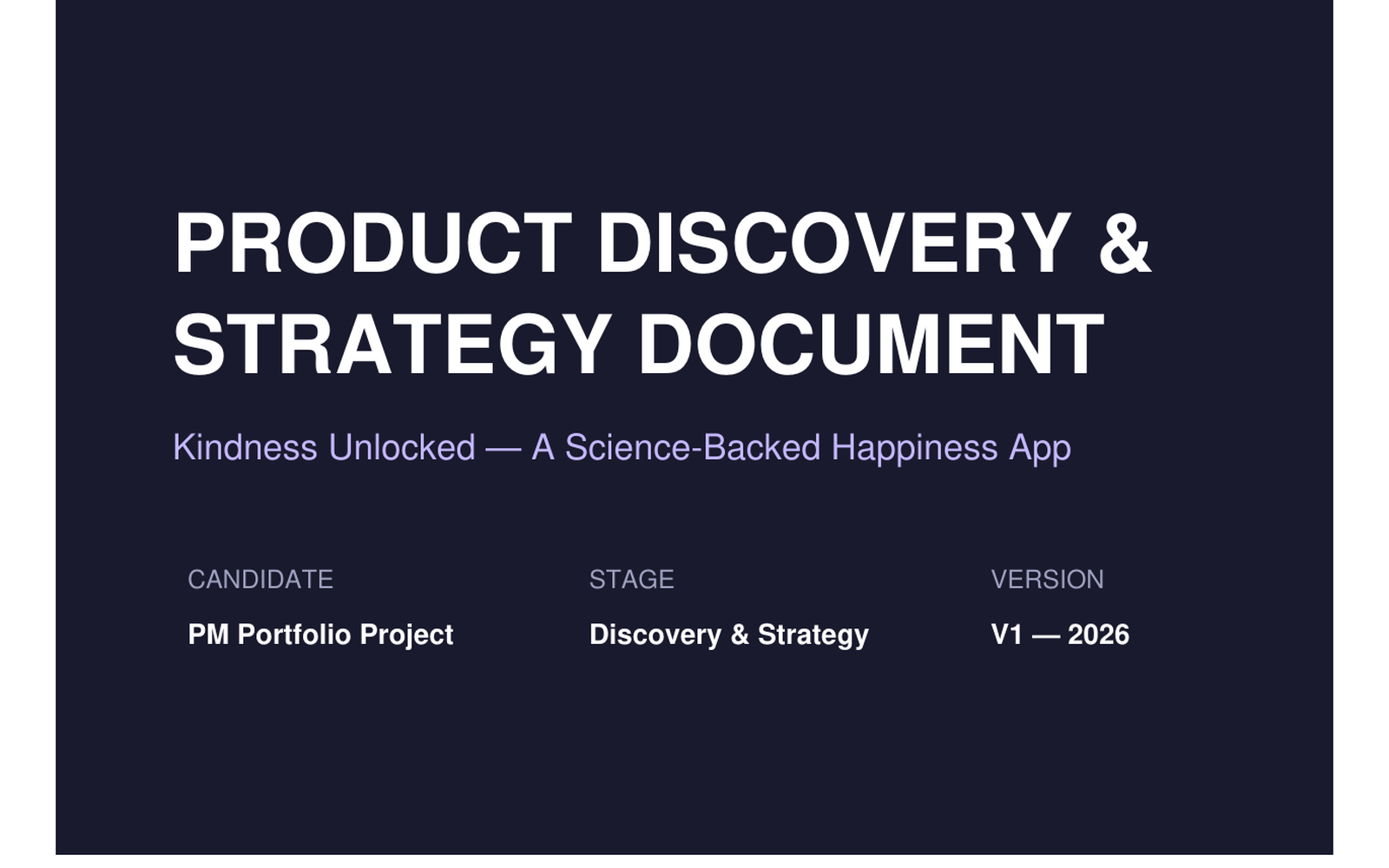
Before Wellward broadened into a larger well-being concept, I scoped the first product thesis around one intervention: acts of kindness.
I turned that idea into a candidate-stage discovery and strategy document with an initial problem statement, target-user hypothesis, competitive landscape, V1 scope, roadmap, and research plan. I treated it as a hypothesis to challenge through research—not as a finished answer.
An early strategy artifact documenting the first version of the idea: a kindness-focused product designed to test one behavioral mechanism before expanding into a broader platform.
The deeper opportunity appeared larger than generating novel kindness prompts. Across the research, psychologically useful practices could become repetitive, rigid, or performative once they entered everyday life.
That shifted the question from:
'How might I generate better kindness prompts?'
to:
'How might a product help people sustain well-being practices without turning well-being into another obligation?'
What did users actually say? I inspected critical and long-term-use reviews for recurring qualitative patterns, then separated observations from product interpretation.
Research artifact 02
Subscription friction repeatedly appeared in critical reviews
Recent critical reviews repeatedly surfaced frustration around premium prompts, subscription expectations, trial and refund confusion, and interruptions to the core gratitude experience. That made monetization friction a trust issue—not simply a pricing issue.
Even when users liked the underlying gratitude concept, aggressive or confusing monetization could disrupt the experience and weaken trust.
Product implication
Monetization should not interrupt the psychological practice the product is asking users to build.
A recurring qualitative pattern in competitor reviews, not a statistically validated result.
Research artifact 03
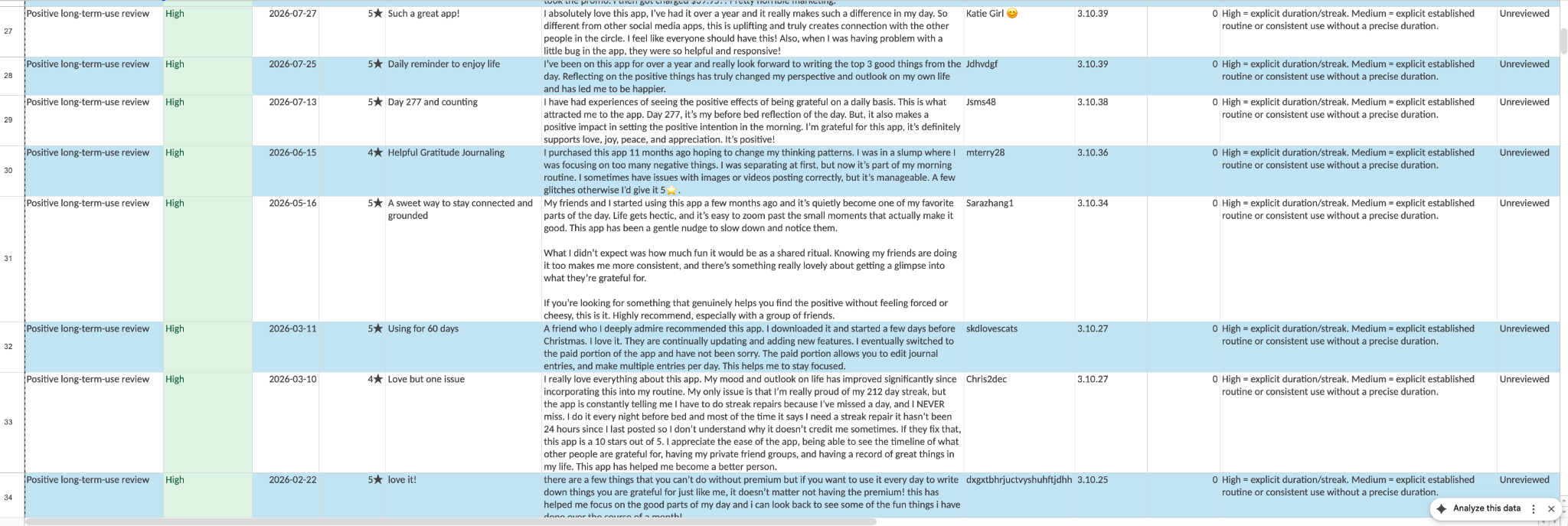
The product was becoming a ritual, not just a journal
Long-term-use reviews described gratitude becoming part of recurring morning or bedtime routines. The sample included users describing more than a year of use, a 277-day practice, and a 212-day streak. Some also described practicing gratitude with friends or family, suggesting that the social layer could become part of the ritual itself.
Reviews referenced months or more than a year of use.
Routine integration
Some users described gratitude as a morning or bedtime practice.
Social ritual
Some users practiced gratitude alongside friends or family.
Interpretation
Social rituals emerged as a possible contributor to sustained engagement.
Product implication
Shared practice became strategically interesting for Wellward. Whether those behaviors transfer to this concept still needs validation.
How careful was the interpretation?
Research discipline
Separating evidence from inference
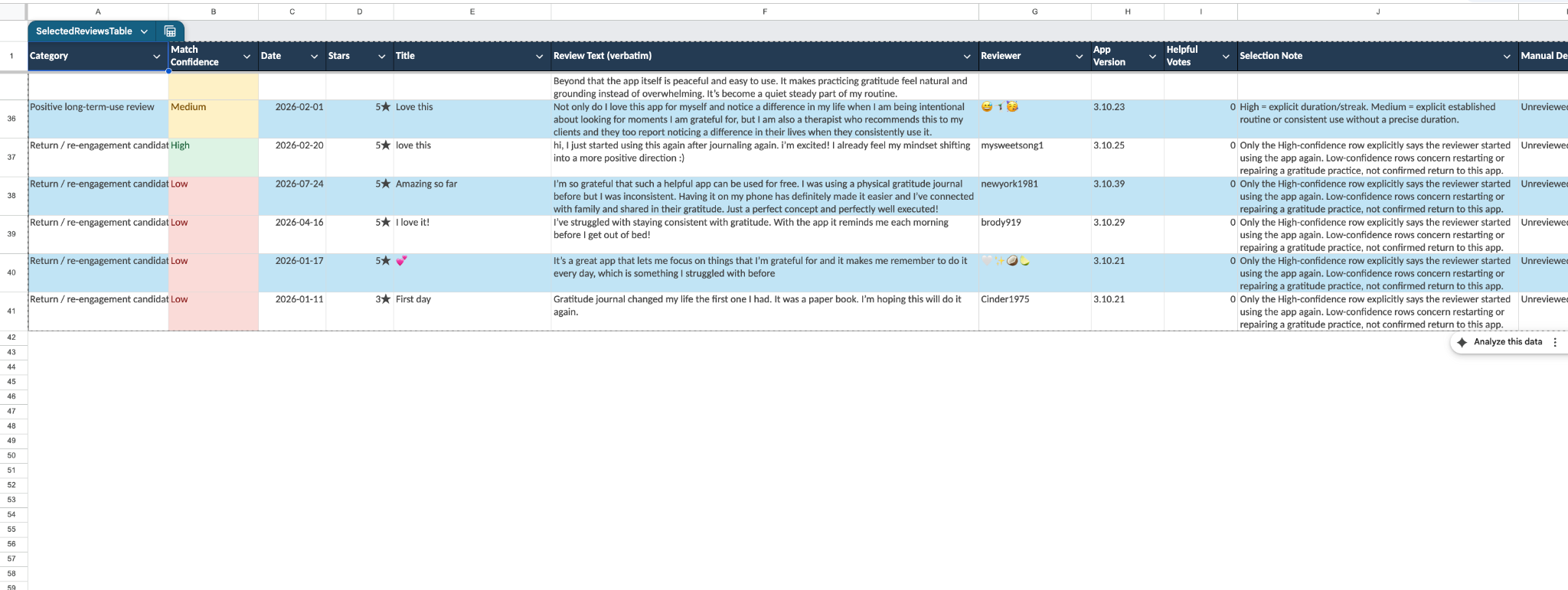
I found five possible re-engagement signals, but only one review explicitly stated that the person had started using Gratitude Plus again. The other four discussed restarting or sustaining a gratitude practice, so I labeled them low-confidence rather than counting them as confirmed product returns.
Low-confidence evidence stayed low-confidence. Weak signals did not become validation.
From reviews to product judgment
The point of the analysis was not to collect competitor features. It was to understand which behaviors, expectations, and sources of friction might matter for Wellward.
Raw reviews
Structured sample
Patterns
Interpretation
Product decisions
Competitor analysis wasn’t a feature shopping list.
I used competitors to understand expectations, unmet needs, and behaviors—then asked which opportunities actually fit Wellward’s philosophy.
The hard part wasn’t generating ideas. It was killing them.
12concepts→3MVP practices
Productization clarityEngineering feasibilityCostSafetyLaunch riskUser value
Each candidate concept was based on one of the 12 happiness practices in The How of Happiness. Engineering had roughly one summer build window, so feasibility and cost were the first filters. More complex or engineering-intensive practices moved to the backlog.
Safety and launch risk came next. Practices such as forgiveness were psychologically intimate and could involve painful, highly personal experiences. I questioned whether a lightweight self-guided product should facilitate them without greater clinical involvement.
User value mattered, but was less useful as a differentiator because all 12 practices had some evidence-informed value. The harder question was which could become clear, usable, safe, and buildable software experiences.
A scientifically supported intervention is not automatically a good software feature.
The prioritization decisions
Qualitative judgments for this MVP scope—not a numerical scoring system or clinical safety assessment.
All 12 candidate practices and their MVP decisions
Practice
Productization clarity
Engineering complexity
Safety / launch risk
MVP fit
Decision
Reason
Random Acts of Kindness
High
Low–Medium
Low
Strong
MVP ✓
Clear interaction and feasible for V1
Expressing Gratitude
High
Low–Medium
Low
Strong
MVP ✓
Clear interaction and feasible for V1
Savoring Life's Joys
High
Low–Medium
Low
Strong
MVP ✓
Clear interaction and feasible for V1
Learning to Forgive
Medium
Medium
High
No
Defer
Psychologically intimate; may require more clinical support
Flow Experiences
Low
Medium
Low
No
Defer
Hard to translate into a clear app interaction
Cultivating Optimism
Medium
High
Low
No
Defer
Higher engineering complexity for V1
Nurturing Relationships
Low
High
Low
No
Defer
Product experience was less clearly defined and technically heavier
Coping Strategies
Low
High
Low
No
Defer
Broad concept with high product and engineering ambiguity
Committing to Goals
Medium
Medium
Low
No
Defer
Moderate product clarity and engineering effort; not selected for V1
Religion / Spirituality
—
High
Medium
No
Defer
Existing products already serve this space
Physical Self-Care
—
High
Low
No
Defer
Fitness and physical-wellness apps already serve this need
Avoiding Overthinking / Social Comparison
Low
Unclear / High
Medium
No
Defer
Unclear what the actual software intervention should be
01
Random acts of kindness
Clear behavioral action with room for variation and novelty.
02
Expressing gratitude
A familiar psychological practice that can become a lightweight repeatable interaction.
03
Savoring
A way to deliberately extend attention toward positive experiences.
These three created a manageable starting point: helping users intentionally practice behaviors associated with well-being without trying to turn all 12 practices into a product at once.
06 / WELLWARD
A sharper working hypothesis about the user.
As the concept evolved, I sharpened the target user into a working hypothesis rather than treating the audience as simply “people who want to be happier.”
Self-directed, evidence-oriented people who want psychological depth without being treated like children by their wellness app.
Working hypothesis · Not validated segmentation
The Intentional Upgrader
Late 20s – early 40s
Already on the wellness journey—gym, journaling, maybe therapy or meditation. Their inward practice feels established, but something still feels missing. They want to grow outward.
Curious about the science of happiness
Readers and listeners of books, podcasts, and self-development content
Already practicing some form of wellness
Not complete beginners; they want to level up
Age range and entry point into wellness apps still need validation through user interviews and surveys.
This is not an onboarding app. It is an upgrading app.
The intended audience already has a wellness foundation and is ready to add an outward, social dimension to their practice.
07 / WELLWARD
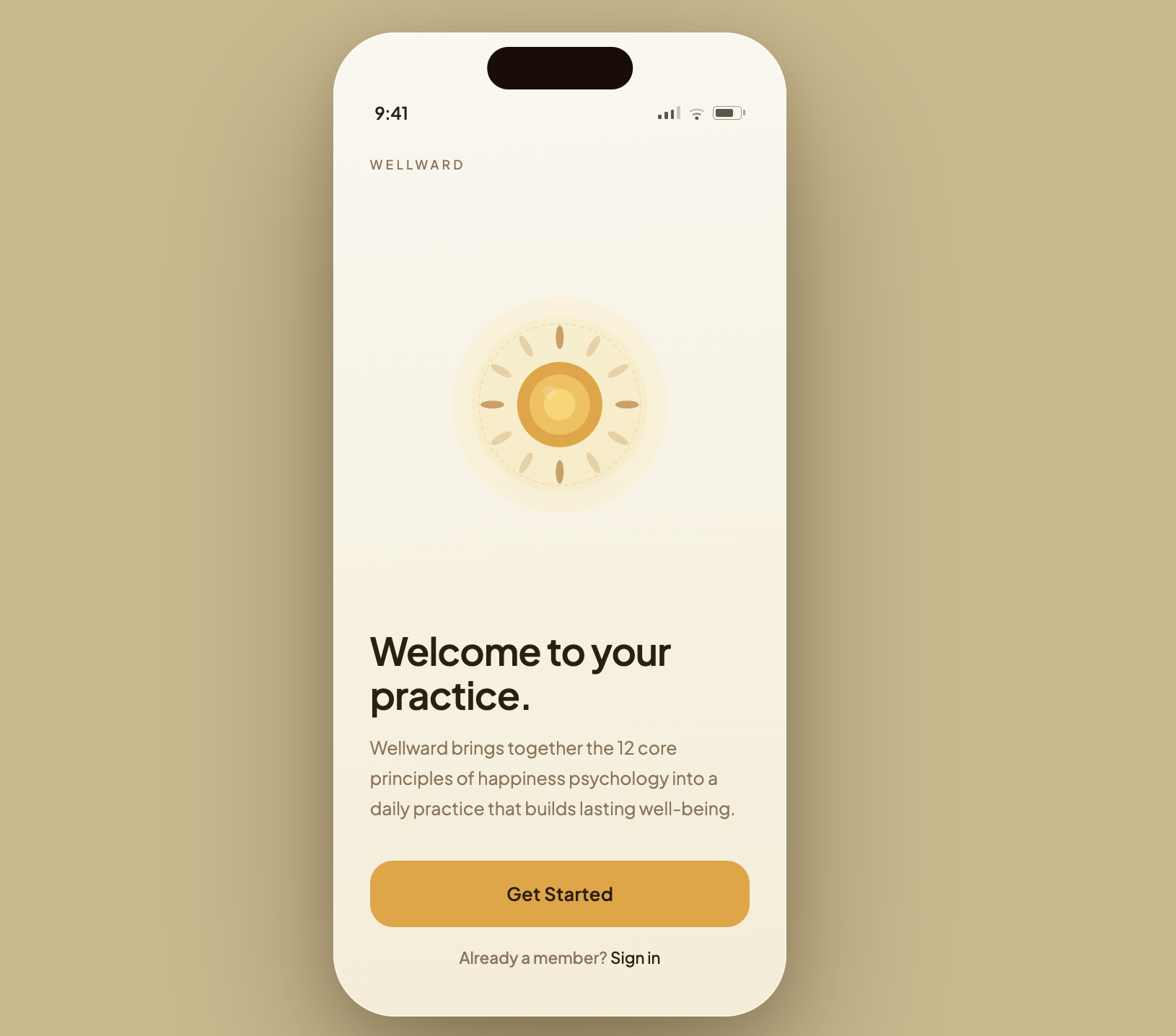
From psychological theory to interface.
Wellward began with a question: if people adapt to temporary changes in happiness, could a product help them build more durable psychological practices instead?
Exploring the difficulty of sustaining gratitude, savoring, and kindness—and analyzing 500 competitor reviews—shaped a calmer direction centered on intentional practice rather than compulsive engagement.